A MOMENT OF GRACE

This morning I pulled up to a traffic light with a few other cars and stayed still with my foot on the brake for a minute or so after the light turned green. I sat a couple of car lengths back from the cross walk, in the middle lane, so I had a pretty good view of the intersection. To my left a woman and a young man moved ever so slowly across the street. At first I thought the woman was his mother, for her face radiated patience and acceptance, and was reflected in the face of the young man as unadulterated trust.

She looked back over her shoulder, her arm extended backwards, clutching the outstretched hand of the young man in her own. She wasn’t quite dragging him, but he was obviously moving faster than he wanted to as his feet stumbled clumsily along behind her. He had on a blue tee-shirt, shiny blue and black-edged basketball shorts, white cotton athletic socks, and blue and silver sneakers. She wore a bright red shirt.

On the opposite corner, clustered around the walk light at the edge of the cross walk, stood four other young people and another red-shirted woman, all watching intently as the first woman and her blue-shirted charge moved closer to them. The two women were caretakers of some sort, I realized, and the young people all developmentally and/or physically disabled. The reluctant young man was the most obviously physically impaired. The traffic light turned green as the pair had about a third of the street to still traverse, but no one moved, not even the cars in the far lane that had an unobscured passage in front of them.
As the blue and silver sneakers stumbled closer to the curb and the red-shirted woman stepped up, the eight arms of the waiting young people stretched out to help pull their companion up onto the curb. For a minute he disappeared into the group. They turned as one to cross the next street. I got the same sense as when I have watched a flock of geese fly in and ski across the water for a second as they close their wings and settle down, then turn in unison and wait for the few stragglers to land and regroup with their fellows. This group of young people functioned as a unit. They were happy to be all together again.

The only difference as I prepared to move ahead was that I witnessed the piece I had not seen just a few minutes before. The group of young people clustered and then began to separate. The first four surged ahead of their friend, their heads turning to watch the stopped cars, and quickly crossed the street with their red-shirted guide and time left on the walk light.

They turned together to look back the way they had come. As I stepped on the gas to move ahead with the traffic, I could see the scene repeating itself as the other red-shirted woman once again began to lead her young man across the street. I knew he wouldn’t make it across before the light changed, and the cars, this time from the other direction, would do exactly as the cluster I was with had done.

I thought as I drove home of how profoundly grateful I am for my own children. If I have to be honest, I don’t think I would have been a good parent to a special needs child. I’m pretty sure I would not have had the patience to honor the spirit of such a person. I realize we never know what we can do until we have to do it, but I doubt I would have been able to do as well as I might have liked.

In witnessing this group crossing the street this morning, it was easy to stop in the moment and realize there is so much more to life than my infinitesimal segment of it. Sure, I was busy. Sure, I had places to go and things to do and was in a hurry to get on with it. I am learning, however, that life is not all about me. I had just come from a meeting with a spiritual mentor. We had been discussing doing God’s will vs. our own. “What does that even mean?” we pondered. We had been reading the St. Francis prayer.
It means my gifts are not my own. It means I am not here solely to help myself, or even those I love. Just in case I was wondering, or needed an example, one was put right under my nose. I am strong, and fit, and able. I was gifted with an opportunity to see one person in a perfect position of service to another. Just because I do not feel drawn to that specific work does not mean that I have nothing to give. Nor does it mean that the perfect work for me is not out there. My job now, hopefully very soon, is to find it. I just need to open my eyes and see.

ON BEING A HYPOCRITE

My mother smoked like a chimney. She went through two, maybe three packs of cigarettes a day. She drank like that, too. She watched the booze like a hawk, even fired a housekeeper/nanny I loved dearly she told me many years later, because my mother had secretly marked the rum bottle. That’s how she knew the housekeeper was drinking it, she said. My mother drank Bacardi Light on the rocks. Once in a while she added a splash of water.

Cigarettes were another story. She left packs all over the house. Some were half gone, some were empty, some were new. She smoked Benson & Hedges, hard pack, with a recessed filter.  Nice fresh cellophane-wrapped packs were in the carton she kept in the pantry off the kitchen, next to the dishwasher. When I was a kid, everyone smoked. That was the day when smoking was supposed to be “healthy.” I still remember a billboard a couple of miles from our house with a picture of a doctor in a white coat smoking a cigarette as he smiled off into the distance.

My mother kept book matches next to the cigarettes in the pantry, too. That was before disposable lighters. Lighters in those days were the size of your palm. They were heavy, stainless steel, often engraved with your initials, and you had to change wicks every once in a while, then fill them with lighter fluid. Matches were simpler.

When I was twelve or so, it seemed like everyone I knew started experimenting with smoking. It was easy to take my mother’s cigarettes, some matches, and go to my friend’s house across the street to meet a few other girls behind the neighbor’s garage, and attempt to smoke. One pack lasted a long time. Four of us would stand there and choke and gasp and spit in the name of smoking. Lungs do not like cigarettes. Neither does your brain. They make you dizzy as hell. They taste and smell dreadful. After a while, though, your body somehow adjusts. And not much longer after that, you simply must have a cigarette. Thus was born a nation of nicotine addicts.

By the time I was 15 or so I was a regular smoker. I bought my own cigarettes, and they certainly weren’t my mother’s brand. As long as I didn’t smoke a whole lot, my mother really never said anything. Once when a family friend said he’d seen me sitting in a deli with some friends having a snack and smoking after school, my mother told me I shouldn’t do that because it didn’t look good. Life to her was all about appearances.

By the time I was a senior in high school I smoked in the house. My father had quit when I was very little. One day I walked into the living room with a pack of cigarettes in my hand. My father was watching TV. “Can I have one of those?” he asked.

I thought he thought I had candy in my hand. “These are cigarettes,” I said. “You don’t want one of these.”

“You’d be surprised what I want,” he replied.

I looked at him, down at the cigarettes, and kept walking. I thought he must be kidding. But I paid attention after that to the cigarettes in the ashtray of his car. I borrowed his car regularly. I found a butt every once in a while that wasn’t mine, or my mother’s brand of cigarettes. I had thought the butts were from one of the men who worked for my father. He was always giving them rides. Now I wondered if maybe they were his. It was news to me he snuck around in his car, smoking.

One summer day I was sitting in the living room having a cigarette and my mother walked in. “I forbid you to smoke in the house,” she announced. “I don’t want you smoking here now, put that out.” I looked at my mother like she was nuts. She had never previously indicated a problem with my smoking in the house. “I’m serious,” she said. “I don’t think you should be smoking at all.” The living room had a big sliding glass door with a screen in it. The door was open. She waited a minute for me to respond. “You may not smoke in my house,” she repeated emphatically.

I walked over to the glass door, opened the screen and stepped outside. I turned around to face my mother and continued to smoke, making sure to exhale back into the house. “I told you not to smoke in the house,” she snapped.

“I’m not in the house,” I replied.

Later at the dinner table after my father came home from work, she regaled my father with this story, putting great emphasis on my disrespect and how I shouldn’t be smoking to begin with, that smoking was bad for you, and how urgent it was that I quit immediately. My mother could preach a good sermon when she put her mind to it.

My father let my mother go on for a few minutes while he ate. He usually endured my mother’s tirades in silence. He was as likely to be the subject in question as was I, or even the dog. 

This night he looked at me and rolled his eyes. He put his fork down and looked directly at my mother. “Why don’t you try quitting yourself first,” he said, picking up his fork again. “Then you might have a leg to stand on.”

FULL MOON HOWLING


Though the temperature has dropped about twenty degrees as the twilight deepens and a strong wind picks up, it is still hot enough for me to keep the house shut up. Maybe in an hour or two I will open all the windows and let the night flow through my house in all its breathiness, refreshing what has been bottled and air-conditioned all day. There is something about being able to let in the “real” air here in Colorado that makes me love living here. On the east coast the heat and humidity lock in and the nights rarely cool down much after a blistering day such as it was here. Last I saw, the outdoor temperature gauge in my car read 103 degrees.

I was standing out on my little patio a few minutes ago, looking up at the not-quite-full moon staring back down at me in the gray twilight. The sky slowly darkened behind it. Little bits of cloud were blowing across the sky, sometimes making the moonface look as if its mouth was open in a great, surprised “O.” Though I love the cooling air and the sound of crickets chirping, thoughts of the fires all around me are never far from my mind. I wish I had the capacity of the children I can hear playing in the summer night a few houses away to live so much in the moment. My dog, Mojo, comes out to sit with me in the windy moonlight for the few minutes before I go back in to write. She hates this strange too-early-in-the-season intensely hot weather as much as I do.

My dogs are good company and follow me around my house any time I move from one room to another, but I am getting tired of the absence of another human being in my space. My daughter has moved on to a life beyond college and the anchor I felt holding the space for my children to have some sort of home base seems to serve no purpose now. I feel joy in the realization that I have created a life for myself very different than that of when I was married, but I have found myself reconsidering relationship in a way more serious than it has been for a long time.

I listen to a CD of an acoustic guitarist playing the most beautiful and lilting melodies and I feel drawn to leave this writing and go sit on the patio in the light of the moon. Due to high atmosphere smoke the light is that funny color I’ve only ever seen out over the ocean from the beaches of my childhood. It is an odd sensation, this sliding back and forth in time from present to past, from marriage to childhood to present once more. I know it is simply the life moving in me again after a long silence. The writer, the painter, the moon watching child is reawakening, surprised to find herself sitting in a deck chair on a warm and windy night, full of wonder.  “Was the spot I am sitting in now once covered by that ancient inland sea? Does the moon remember?”

Perhaps it is time to look up at the moon one final time, purse my lips in a great “O,” and howl my lungs out. Oh if only I still lived out in the country where I could do that with abandon instead of here, in a little subdivision of houses only a few dozen feet away from my neighbors. I’ll have to hope you can hear me in your mind. Imagine a middle-aged woman, milky-skinned in the night with a large dog at her feet, a small one in her lap, her head thrown back in the now-black air, open-mouthed and howling, howling at the moon.

SMOKIN’ HOT

Last night I watched on television as the news helicopter flew over the fire on the edge of Boulder, Colorado, not far from where I used to live. Only one ridge, Flagstaff Mountain, separated the new wildfire from the city of Boulder, the news anchor droned. The Feds were being called in to manage the fire because of its proximity to a very highly populated area. Calling in the Feds means it is much easier to allocate firefighting resources, such as the huge tanker planes, to fight the fire. It is taken out of the hands of the State of Colorado. Now I see this morning that Colorado Springs is suffering the same fate. I have friends in both areas. Fires rage in the state all along the I-25 corridor. Even Rocky Mountain National Park is not immune.

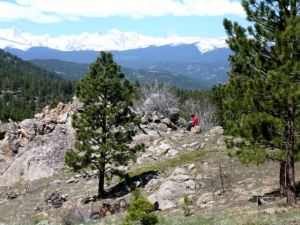
Just two months ago, in April, I was a participant in a writing workshop at a beautiful home near the top of Flagstaff mountain. We were visited across the day by coyote, wild turkeys and deer. There were views from the property through evergreen trees and softly waving Aspen of the snow-capped peaks of the Continental Divide. The air was cool and fresh, and smelled of the sun-warmed earth at altitude. Now I wonder if that same view is through the charred trunks of devastated trees. Now I wonder if the workshop leader’s house is still there. After all, she remarked that day as we were all admiring her house that she and her husband had not culled all of the trees close to the house that were recommended for a fire barrier…in the event of just such a situation as now exists.

Farther down Flagstaff sits the Flagstaff Restaurant, an easy ride up from Boulder for good food and a commanding view of Boulder itself and the surrounding plains. A good friend of mine got married there. My family flew in from across the country, my mother included, to celebrate my mother’s 80th birthday at that restaurant. This is the “ridge” the newscaster was talking about that is the barrier before the fire hits Boulder.

For the past few days it has been beastly hot and dry, close to 100 degrees and more. Each day the sky has gotten dark and purple, the wind has kicked up strongly, and lightning has cracked the evening sky as thunder growled. But each time, despite a slight smell of rain and a few sprinkles of refreshing droplets that don’t even come in enough quantity to wet the cement of the street or sidewalk, nothing much has happened. Only a few lonely puffy thunderheads form along tornado alley, east of I-25.

I felt the fear as I drove to Denver early last Sunday morning and the blanket of smoke from the High Park Fire near where I live now obscured the mountains and stretched out to the east all the way down to south Denver. The fire by Colorado Springs was just beginning that day. I am and will be eternally grateful to all those thousands of men and women who put their lives on the line to fight to contain these fires. My heart hurts for all the people who have lost their homes, their animals, and perhaps their livelihoods. Still, I wonder if there isn’t some broader lesson for us to learn.

It’s only been the last couple of hundred years that human beings have even lived in much number up against or up in the mountains themselves. It was human greed, desire for the gold and silver to be found in the mountains, that brought settlement and the beginnings of what is now Fort Collins and other towns along the Front Range. There really wasn’t much that could be done about wildfires in the mountains before there were planes that could carry significant loads of water and fire retardant. The canyons and ridges just burned. Even the Native Americans stayed out of the mountains as home for large numbers of people. Perhaps the rest of us should do the same.

LIFE’S GIFTS

This morning as I was riding my exercise bike in the gym, I saw an older woman walk between two of the recumbent bikes in the row in front of me. She was followed by a man who only looked marginally more aged. She chose the one on the left, saying it would accommodate the man’s sneakers more easily. She got him going on the bike and walked away.

“I’m 94 years old and still kicking,” he announced to the lady on the bike next to him. As he turned his head to speak, I got to see his face. He had the most beautiful, almost wrinkle-free skin and sparkling blue eyes. He looked like he had at least several more years of life in him, if not a couple of decades. “That was my daughter helping me,” he said. Compared to him, she really hadn’t looked young enough to be his daughter.

The lady on the bike next to him perked up and tried to keep the conversation going. “My, that’s really quite wonderful,” she said.

“Yes, it’s been a long and good life.” He smiled brilliantly, a little mischief sparkling in his eyes as he answered the woman.

“There is a born charmer riding among us,” I thought, listening to them talk.

“My wife died last year,” he said, with no particular note of sadness in his voice.

“Well, then she lived a long life, too,” the woman replied.

“Yes, and it was a good one, too.” He turned to face the bank of televisions, perhaps to think about his wife. My time on my bike was up, and I left to move on to other exercise.

My grandfather had beautiful skin like that. He lived to be 98 and didn’t stop working until he was 93. His mind could have kept going, but he felt his hearing and eyesight made the job too hard and he needed to retire. He could be a sweetie, too, and older ladies flocked around my grandfather like hens around a rooster after my grandmother passed away. It’s not just men who are so blessed; certain older women seem to have that same charm, too.

Maybe it’s just a certain satisfaction with the way things worked out that radiates from and draws the rest of us in to people like this. We all hope that old age will be healthy and we can keep finding life interesting and fulfilling right up until the end. To me these older people still burn with a fire of connection to their world. Based on the few people I’ve had the privilege to know in my life like this, they are often unusually intelligent, too.

My grandfather was born at the very end of the 19th century. He so wanted to make it to the 21st century, but he didn’t get his wish. “It’s been a fascinating journey,” he once said. He looked forward to all the new things he saw and learned each year.

His life began in horse and buggy times, riding in the winter as a child wrapped in wool blankets, to the sound of sleigh bells ringing on the back of a trotting horse.  “We used to ride down that long hill, through town, and right across the frozen river to the other side,” he’d told me one day, pointing from the porch of the family home into the distance, tracing the path of the sleigh in the air.

 It’s actually my mother who would be almost exactly the age of the man on the recumbent bike today, but she only made it to 85. I remember my mother and her excitement when her friend sent her CD’s and a CD player when they first came out. “Little metal records!” she’d exclaimed. I thought that hilarious, then.

Now I get to be befuddled by the world as it’s been created and connected by the internet. It is so easy to find the answers to even complicated questions. “Just Google it, Ma,” my son often says to me when I struggle to remember something I think I know. The world has become “flatter” as they say, borders so much easier to cross. Interesting times, indeed.

FIRE AND HEAT

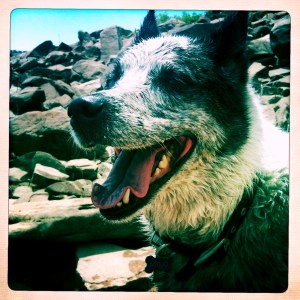
My little dog curls his tongue in his open mouth as he trots along next to the curb on our usual walk. It is hot already though the morning is still young, and I feel a chill as I look at the yellow-white plume of smoke from the forest fire just a few miles north of us. The light is often deceptive against the mountains, making things look either much closer or much farther away than they really are. This morning the fire looks as if it is just on the other side of town, when in reality it is miles away.

Hot weather, close to 100 degrees, is predicted for later today. Wind, anathema to the work of the firefighters, is predicted to rush across the state, further drying the air and threatening to carry the fire across the barriers they have worked so hard to establish. It is not all bad news, though; the fire seems to be holding at 45% containment.

The newspaper this morning shows a picture of a 700-pound tranquillized and blindfolded young moose being carried in a stretcher to a waiting vehicle, where he will be transported and relocated away from the fire. He had swum across a local reservoir and ended up in town, much to the consternation of the people whose properties he traversed.

Supposedly there are at least two more moose that have sequestered themselves in small parks under the watchful eye of the local authorities. It is not only people whose lives are transmuted by a great fire. We humans seem to have considerably more difficulty being relocated, however.

A childhood friend visited me recently, inspiring me to look at some old artwork I’d painted years ago in a new way. She is also my “best audience,” to quote Stephen King from his book, On Writing, when it comes to my writing.

You need to get this stuff framed,” she said. “You could have your own art show, today,” she said. “It’s amazing stuff, and I think I am pretty well qualified to say so.” She also nagged me to set up the blog I’ve been thinking about for months. Her enthusiasm is catching. Her high energy personality is one of the things I’ve liked from the beginning. We’ve been friends since the sixth grade.

I’ve been divorced close to four years now. I left my marriage just before what would have been our thirtieth wedding anniversary. I’ve felt emotionally like I imagine that burned out land behind the wildfire might feel; crisped, consumed, lifeless, almost totally barren of hope for any recovery.

I learned a few years ago, however, that there are seeds that only sprout when they have been through a fire. Nature has its own way, an orderly progression, as to how the mountains will be reforested, with or without the help of man. Perhaps, thanks to my friend, so do I. Pine bark beetles devastated millions of trees in the state, contributing unimaginable acres of tinder for the fires. My marriage had its own form of pine bark beetles, killing what had been good and strong and green until it finally consumed itself and fizzled out.

A couple of days ago my just-turned-twenty-one-year-old son came over to ask me for a favor, which I was happy to grant. He looked at the newly framed art on the wall and saw also that I had hung up a little sculpture my friend had brought me, just as she had suggested when we all sat at dinner one night. He stood in silence for a minute, inspecting a painting. “She really is your best friend,” he said.

EYE OF THE BEHOLDER

I live in a tiny town in Colorado that is part of what is known as “The Front Range.” This is a series of towns and cities that are mostly sandwiched between the foothills of the Rocky Mountains and the only major north-south interstate in Colorado, I-25. In my mind the Front Range ends with Fort Collins in the north, and Colorado Springs in the south. The majority of the present population of the state lives here. To give you some perspective, Denver straddles both sides of the middle of I-25.

When my family first moved to Colorado almost twenty years ago, we landed in Boulder, which is nestled right up against and spreads up into the foothills themselves. The beginnings of the Rocky Mountains are riddled with beautiful canyons, hiking trails, national forests, and breathtaking views of above-the-timberline snow-capped peaks.

Looking out to the east you see spectacular nighttime views of sparkling city lights. On a hot summer day as the evening closes in, you can sometimes watch the birth of towering thunderheads a few miles out across the plains, flashing with bolts of lightning zapping to the ground and cloud to cloud. Newcomers flock to the new subdivisions being built. The more adventurous rush to populate the tiny towns higher up a couple of thousand feet. No doubt about it, this is a breath-taking place to live.

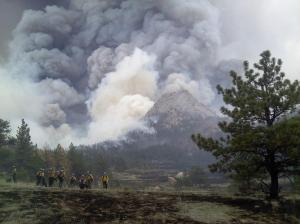
Last Saturday, just a week ago now, one of the reasons you might want to rethink living in the foothills began. The High Park fire started with a bolt of lightning, but could just as easily have started with a careless human act. What started as a 300 acre conflagration this time last week, is now a 50,000 acre monster very reluctantly giving up its intent to consume everything in sight. Over a thousand firefighters have put their hearts and souls into taming the blaze, putting themselves at risk to save the lives and property not only of other people, but some also leaving their own homes to the luck of the draw in order to serve the larger good of the city of Fort Collins.

The topography of all that natural beauty makes firefighting a nightmare. Big equipment is almost impossible to get up the dirt canyon roads. What air tankers are available don’t always have a convenient lake to dip into for water. Manpower is stretched thin as fires rage in other places of the American West. Last week the smoke plume carried up into South Dakota. A day later a temperature inversion brought the smoke into my house and yard with eye-stinging intensity, and I live almost twenty miles south of the fire.

Still, I couldn’t help but catch my breath as I drove home from Fort Collins on the interstate Wednesday evening just about sunset. The interstate runs north and south almost seven miles east of the fire. Against the darkening jag of the mountains, a brilliant orange sun sank into the west. Here and there a puffy cloud turned thunderstorm purple with a magnificent rose/magenta/orange belly. But the most glorious sight of all was the fire-plume itself.

An immense fishhook shaped arm reached up and across the sky as far as the eye could see. As I left the interstate and headed west toward the mountains and my home, I could hardly keep my eyes on the road. I had not previously seen the fire from that distance until that minute. To my right up north against the mountains, the sun lit the smoke plume not from above or below, but right directly through its center and across the miles of flat, drawn out immensity.

The darker shades of purple and blue and gray mixed with sickly yellow and off-white. It was the reds and oranges and pinks that really got me. Backlit by the setting sun, all the gorgeous colors of a comforting home-hearth based fire roiled against the sky. Though I knew exactly what that plume meant for the land, the animals, and the people whose lives would be changed forever by its existence, I couldn’t help myself.

It was one of the loveliest things I’ve ever seen. It was beautiful beyond belief. I was grateful it was there for me to see. Even if it also meant destruction and death, seeing it was a gift.